How to connect Google Calendar MCP with Cursor

How to integrate Google Calendar MCP with Cursor Cursor is one of the leading AI-powered code editors. It is built to help developers write, understand, and refactor code faster with AI assistance built directly into the editor. And in this guide, I will explain the easiest and most secure way to connect your Google Calendar account to Cursor via Composio Connect, so it can create a meeting with the marketing team, list all events scheduled for next week, delete tomorrow’s canceled event from your calendar, and more without ever putting your account credentials at risk.

Google Calendar logoGoogle Calendar
Oauth2

Google Calendar is a time management service for scheduling meetings, events, and reminders. It streamlines personal and team organization with integrated notifications and sharing options.

44 Tools7 Triggers

How to integrate Google Calendar MCP with Cursor

Cursor is one of the leading AI-powered code editors. It is built to help developers write, understand, and refactor code faster with AI assistance built directly into the editor.

And in this guide, I will explain the easiest and most secure way to connect your Google Calendar account to Cursor via Composio Connect, so it can create a meeting with the marketing team, list all events scheduled for next week, delete tomorrow’s canceled event from your calendar, and more without ever putting your account credentials at risk.

Also integrate Google Calendar with

Why Composio?

  • 1,000+ SaaS toolkits out of the box. Skip the work of building and maintaining integrations, Composio gives you instant access to a vast catalog of pre-built connectors.
  • One MCP server for every app. Connect any of your applications on demand through a single endpoint, rather than juggling a separate server for each app.
  • Smart, context-aware tool loading. Unlike traditional MCP servers that dump every available tool into the LLM context window, Composio searches for and loads only the tools relevant to the task at hand. A remote CLI workbench lets LLMs compose these tools into workflows for complex automation.

Connect Google Calendar to Cursor

Two ways to install — pick whichever you prefer.

1. Install with one click

Click the button below to add Composio to Cursor.

Install in Cursor

2. Or add manually

Add to your Cursor mcp.json

Open .cursor/mcp.json in your project root (or ~/.cursor/mcp.json for global config) and add the following configuration:

bash
{
  "servers": {
    "composio": {
      "type": "http",
      "url": "https://connect.composio.dev/mcp"
    }
  }
}

3. Authorize

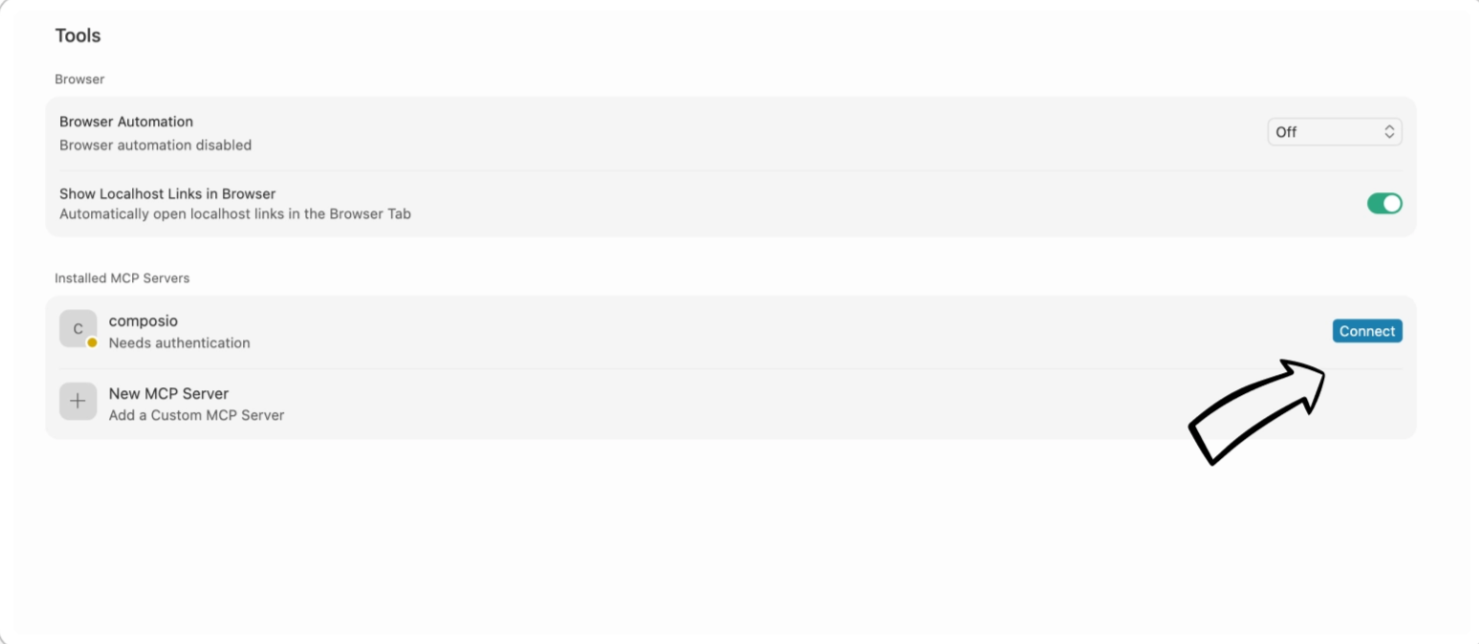
Restart Cursor, then click "Connect" next to Composio in MCP Tools settings.

Cursor MCP Tools settings with Connect button next to Composio

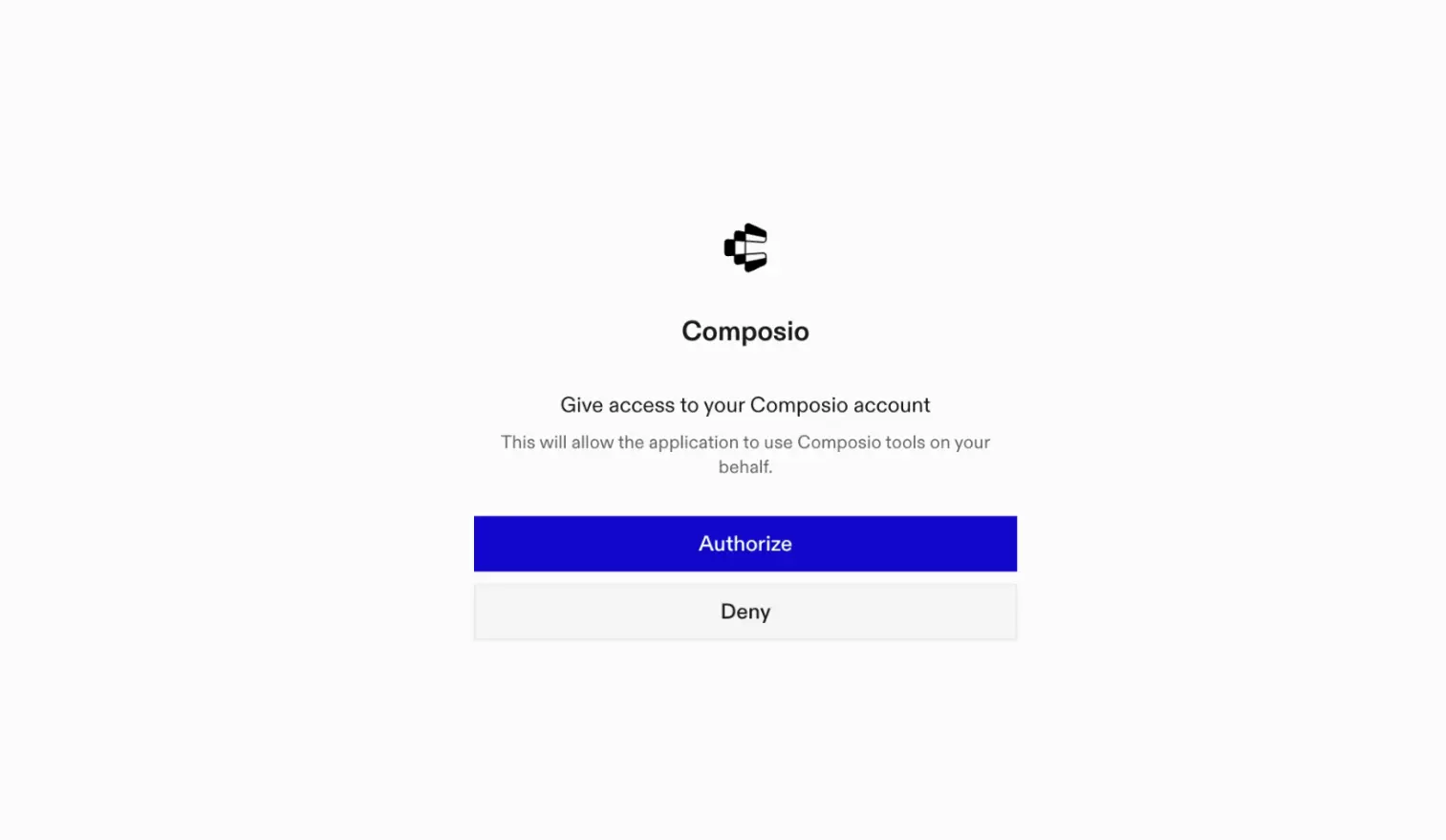
A browser window will open to authorize.

Composio authorization browser window

Connect your Google Calendar account

Back in Cursor, ask the agent to connect to Google Calendar or give it any Google Calendar-related task.

For example, ask it to:

  • "Create a meeting with the marketing team"
  • "List all events scheduled for next week"
  • "Delete tomorrow’s canceled event from your calendar"

It will prompt you to authenticate and authorize access to Google Calendar.

That is it. Composio tools are now available in Cursor, and your Google Calendar account is ready to use.

Conclusion

You have successfully connected Google Calendar to Cursor using Composio Connect. Your agent can now use Google Calendar securely without exposing credentials in prompts or local scripts.

TOOLS & TRIGGERS

Supported Tools and Triggers

Every Google Calendar action and event your agent gets out of the box.

Delete ACL Rule

Deletes an access control rule from a Google Calendar.

Get ACL Rule

Retrieves a specific access control rule for a calendar.

Create ACL Rule

Creates an access control rule for a calendar.

List ACL Rules

Retrieves the list of access control rules (ACLs) for a specified calendar, providing the necessary 'rule_id' values required for updating specific ACL rules.

Patch ACL Rule

Updates an existing access control rule for a calendar using patch semantics (partial update).

Update ACL Rule

Updates an access control rule for the specified calendar.

Watch ACL Changes

Tool to watch for changes to ACL resources.

Batch Events

Execute up to 1000 event mutations (create/patch/delete) in one Google Calendar HTTP batch request with per-item status/results.

Remove Calendar from List

Tool to remove a calendar from the user's calendar list.

Get Single Calendar by ID

Retrieves metadata for a SINGLE specific calendar from the user's calendar list by its calendar ID.

Insert Calendar into List

Inserts an existing calendar into the user's calendar list, making it visible in the UI.

Patch Calendar List Entry

Updates an existing calendar on the user's calendar list using patch semantics.

Update Calendar List Entry

Updates a calendar list entry's display/subscription settings (color, visibility, reminders, selection) for the authenticated user — does not modify the underlying calendar resource (title, timezone, etc.

Watch Calendar List

Watch for changes to CalendarList resources using push notifications.

Delete Calendar

Deletes a secondary calendar that you own or have delete permissions on.

Update Calendar

Full PUT-style update that overwrites all calendar metadata fields; unspecified optional fields are cleared.

Stop Channel

Tool to stop watching resources through a notification channel.

Clear Calendar

Clears a primary calendar by deleting all events from it.

Get Color Definitions

Returns the color definitions for calendars and events.

Create Event

Create a Google Calendar event using start_datetime plus duration fields.

Delete event

Deletes a specified event by `event_id` from a Google Calendar (`calendar_id`); idempotent — a 404 for an already-deleted event is a no-op.

Create a calendar

Creates a new, empty Google Calendar with the specified title (summary).

Get Event

Retrieves a SINGLE event by its unique event_id (REQUIRED).

Import Event

Tool to import an event as a private copy to a calendar.

Get Event Instances

Returns instances of the specified recurring event.

List Events

Returns events on the specified calendar.

List Events from All Calendars

Return a unified event list across all calendars in the user's calendar list for a given time range.

Move Event

Moves an event to another calendar, i.

Watch Events

Watch for changes to Events resources.

Find event

Finds events in a specified Google Calendar using text query, time ranges (event start/end, last modification), and event types.

Find free slots

Finds both free and busy time slots in Google Calendars for specified calendars within a defined time range.

Get Google Calendar

Retrieves a specific Google Calendar, identified by `calendar_id`, to which the authenticated user has access.

Get current date and time

Gets the current date and time, allowing for a specific timezone offset.

List Buildings

Lists all buildings for a Google Workspace customer account with full details including addresses, coordinates, and floor names.

List Calendar Resources

Retrieves calendar resources (such as conference rooms) from a Google Workspace domain using the Admin SDK Directory API.

List Google Calendars

Retrieves calendars from the user's Google Calendar list, with options for pagination and filtering.

Patch Calendar

Partially updates (PATCHes) an existing Google Calendar, modifying only the fields provided.

Patch Event

Update specified fields of an existing event in a Google Calendar using patch semantics (array fields like `attendees` are fully replaced if provided); ensure the `calendar_id` and `event_id` are valid and the user has write access to the calendar.

Quick Add Event

Parses natural language text to quickly create a basic Google Calendar event with its title, date, and time, suitable for simple scheduling; does not support direct attendee addition or recurring events, and `calendar_id` must be valid if not 'primary'.

Remove attendee from event

Removes an attendee from a specified event in a Google Calendar; the calendar and event must exist.

Get Calendar Setting

Tool to return a single user setting for the authenticated user.

List Settings

Returns all user settings for the authenticated user.

Watch Settings

Watch for changes to Settings resources.

Update Google event

Updates an existing event in Google Calendar.

FAQ

Frequently asked questions

With a standalone Google Calendar MCP server, the agents and LLMs can only access a fixed set of Google Calendar tools tied to that server. However, with the Composio Tool Router, agents can dynamically load tools from Google Calendar and many other apps based on the task at hand, all through a single MCP endpoint.

Yes, you can. Cursor fully supports MCP integration. You get structured tool calling, message history handling, and model orchestration while Tool Router takes care of discovering and serving the right Google Calendar tools.

Yes, absolutely. You can configure which Google Calendar scopes and actions are allowed when connecting your account to Composio. You can also bring your own OAuth credentials or API configuration so you keep full control over what the agent can do.

All sensitive data such as tokens, keys, and configuration is fully encrypted at rest and in transit. Composio is SOC 2 Type 2 compliant and follows strict security practices so your Google Calendar data and credentials are handled as safely as possible.

Start with Google Calendar.It takes 30 seconds.

Managed auth, hosted MCP servers, and every Google Calendar tool your agent needs.Free to start.

Start building